

New: How Scientists are Saving Coral Reefs with Genetic Editing
Genetic barcoding may offer the first scalable, non-invasive way to measure whether coral reefs are truly recovering

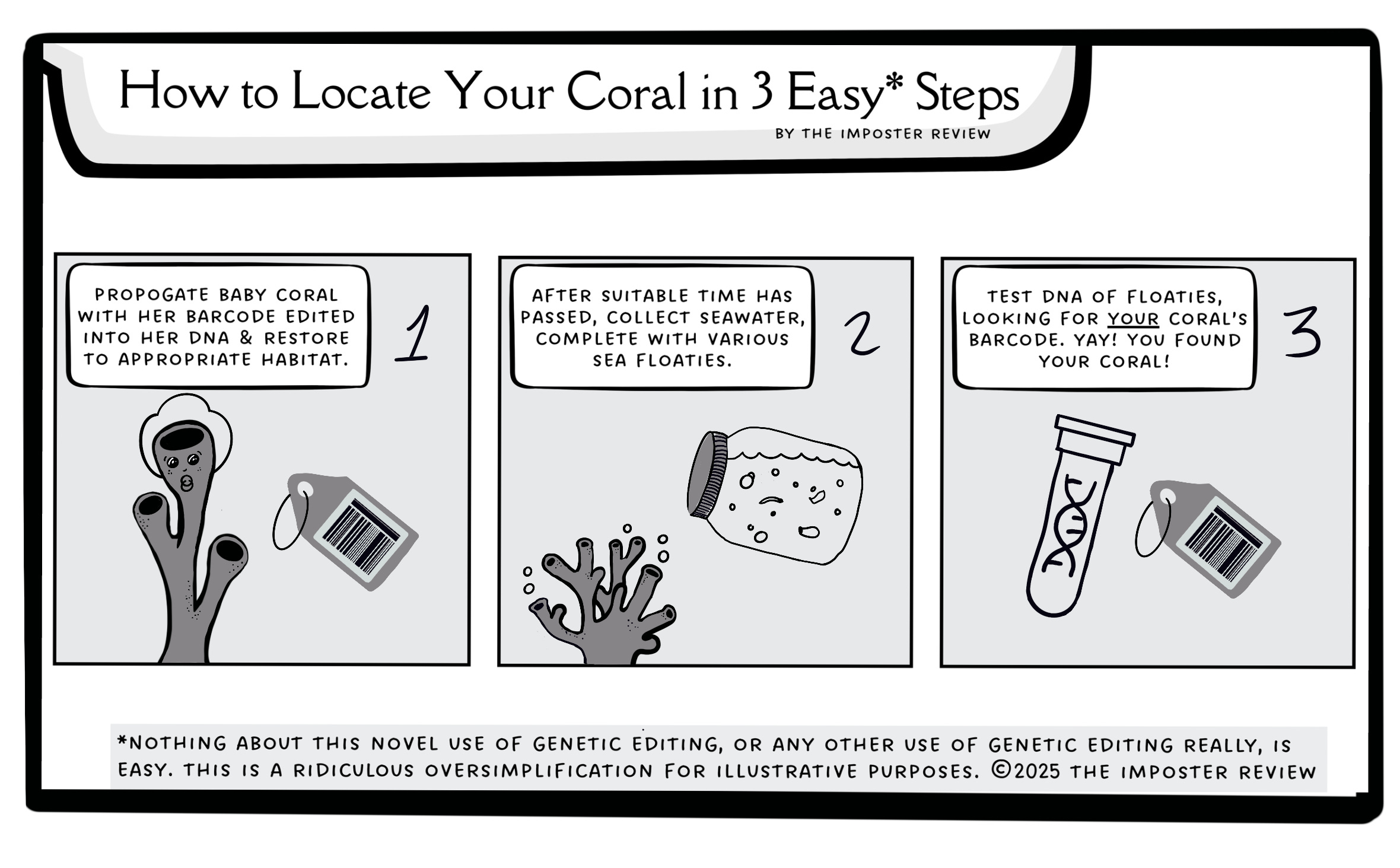
Researchers at the Australian Institute for Marine Science have come up with a novel way of barcoding coral being reintroduced to the wild in order to track their survival and reproduction. They’re using the Nobel prize-winning genetic editing tool CRISPR-Cas9 to introduce a snippet of code into the coral’s DNA. This allows them to not only track the individuals, but their offspring as well, simply by testing seawater.
Trouble on the Reef
Corals are tiny marine animals, some of which absorb algae as their food source, which can turn the coral their signature bright color. Certain species excrete calcium carbonate (found in chalk, limestone, eggshells) which is what forms their solid exoskeleton, and also forms coral reefs.
Here’s where we have a problem. These reefs provide homes and food for a quarter of the world’s marine life. Rising ocean temperatures and decreased water quality are associated with a phenomenon called coral bleaching, where stressed coral colonies expel the algae, turning white in the process. If after bleaching, their environments do not return to a more suitable habitat, the coral then dies. An estimated 84% of the world’s reefs have experienced bleaching. Scientists are trying to propagate coral and then restore them to habitats where reefs have been damaged.
Introducing lab-grown baby coral into the wild is only effective if marine biologists can track the coral, follow their long-term survival rates, and those of their offspring. But coral reproductive cells float off into the ocean. This means baby coral can end up quite far from their parents. That’s why determining whether the rebuilding of coral reefs is working long term is tough.
Barcoding DNA
Historically, marine biologists looking to track animals and their offspring have relied on the physical tags that require monitoring by divers. These studies are expensive and logistically challenging. By adding an engineered barcode to a non-coding, non-functional section of the coral’s DNA, scientists are able to detect the success of coral reef restoration projects just by DNA testing seawater.
That’s because the corals leave behind residue that contains DNA just like any other animal, such as waste products, broken fragments, etc. Scientists call this environmental DNA or eDNA and it’s an increasingly rich field of study (See sidebar).
In the case of coral, their eDNA floats around in seawater. When researchers sample the water, they can now look for the engineered barcode they edited into the genome of the coral, and learn if their reef restoration worked, according to the AIMS website:
“After we collect water samples from a reef, we can extract the DNA from that water. We then sift through this DNA from the sampling area to see how many unique reads of DNA we find. This tells us about the genetic diversity of the population where the sample was taken. The more unique sequences we find, the higher the genetic diversity of the population.”
Non-Invasive Monitoring
The eDNA data is a gold mine of information. Did the corals survive? Did they reproduce? Researchers will be able to assess the long term success of coral reef restoration projects taking place in areas of study, because the engineered barcode will be passed down to the corals’ offspring.
This longitudinal data is particularly important, as corals can live for hundreds, even thousands of years. The researchers believe their barcoding method will provide a practical means to monitor the long term health and survival of restored reefs in a non-invasive way.
Sidebar: What is eDNA?
Environmental DNA (eDNA) is the genetic material shed by organisms into their surroundings. This can include skin cells, hair, pollen, and (ugh) waste products. Basically, any biological traces we leave behind.
By collecting samples of water, soil, or even air and sequencing the DNA fragments inside, scientists can detect which species are present, without ever needing to see or capture them. This makes eDNA a powerful, non-invasive tool for biodiversity monitoring, invasive species detection, and ecological research. It’s also why you probably don’t really want to know what makes up the dust in your home, which at my house I think is mostly sheepadoodle fur.
Hey while I have you…do you know someone who likes the latest science news in plain English? With the odd comic doodle thrown in? If so, please forward them this article and ask them to subscribe. My Substack is only a week old, and like a baby coral in the ocean, I want to know that it’s thriving. You’d help me out a lot if you tell just one of your science-y friends about The Imposter Review.
Sources:
https://www.biorxiv.org/content/10.1101/2025.09.11.675722v1.full.pdf https://icriforum.org/4gbe-2025/